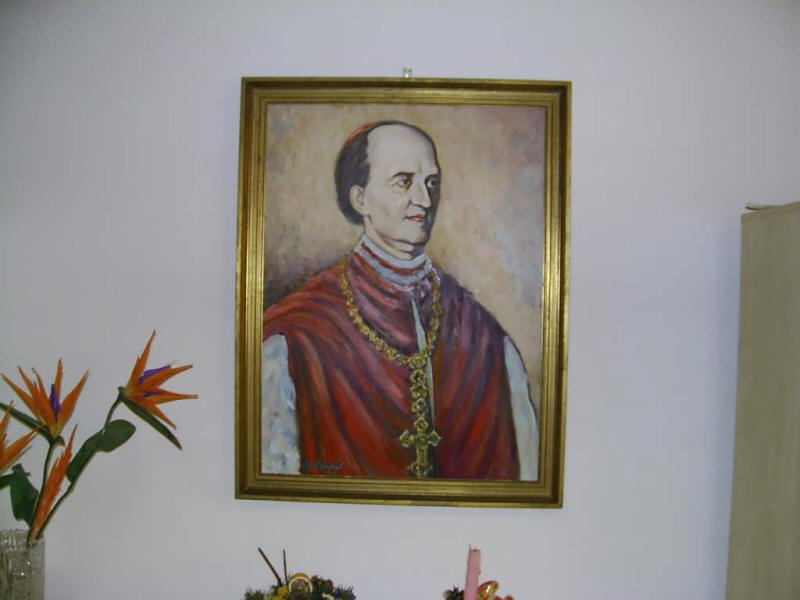



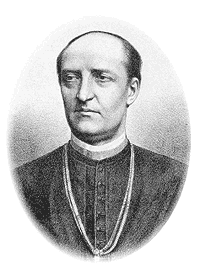
Arnold Ipolyi
(1823 – 1886)
Arnold Ipolyi, a pioneering figure of 19th‑century Hungarian cultural history research who wrote the first comprehensive work on Hungarian mythology, was born in October 1823 as the eldest child of Ferenc Stummer, chief constable, and his wife Arzénia Szmrecsányi. The family living in Hont County in Upper Hungary, of German origin – one of whose ancestors, György Stummer, was granted nobility by Maria Theresa in 1741 for his outstanding military valour – was closely related to the prominent county gentry families, and its members held high county offices. The bright and physically well‑developed child was intended by his parents for a military career, but already at the age of twelve he showed a serious interest in history, and under the influence of his teachers he felt a strong attraction to the priesthood. His parents did not oppose his choice. He first completed the philosophy course – by today’s standards, secondary school – at the Emericanum in Bratislava and then at the lyceum in Trnava. Among his teachers, his teachers of Hungarian language and literature and of history had a great impact on the young man’s intellectual development.
As is usual for outstanding students, he went to Vienna, to the Pázmáneum. The atmosphere of the University of Vienna, the rich libraries, museums and picture galleries offered excellent opportunities for the young clerical student to broaden his education.
Ipolyi spent only a few months in the castle of the Pálffy counts, because he was appointed parish priest in Zohor, near Stomfa – the right of appointment belonged to the comital family. After his father suddenly died, Ipolyi was forced to provide for his large family. His two brothers, Gyula and György, as former honvéd (soldiers) of the War of Independence, could not find work anywhere, two of his sisters still needed upbringing, and his brother Lajos, who had been government commissioner of the Békés region during the 1848 Revolution and War of Independence, fled to Turkey.
During the years spent in the parish of Zohor, Ipolyi began his scholarly work. The proximity of Bratislava and Vienna allowed him to regularly visit the libraries there.
His interest in the ancient religion of the Hungarian people – as he himself wrote on the first pages of his Hungarian Mythology – began during his student years and further intensified when in 1846 the Kisfaludy Society announced a competition for a work that would contain everything that can be ascertained regarding the religion of the ancient Hungarians
. These years saw the publication of János Erdélyi’s influential collections, the volumes of Folk Songs and Legends. This period of preparation also marked the beginning of his own ethnographic fieldwork and, at the same time, the organisation of a large collecting network. He often referred in his mythological work to this manuscript collection of tales, legends, folk customs and folk beliefs, which comprised over three hundred items. The texts used in Hungarian Mythology were recorded by Ipolyi between 1846 and 1853, but he continued collecting for another five years, so the collection contains over a thousand texts in total. In 1852 his first study on a historical topic was published under the title Contributions to the History of the Peace of Zsitvatorok. Around that time he also published his first church‑historical writings, such as Sketches on Domestic Church‑Archaeological Monuments – St John’s Hungarian Church at the Franciscans in Bratislava and the Catacombs Existing in Our Country, as well as his work on St Adalbert among the Apostles of the Hungarians, in the journal Religio. Hungarian Mythology appeared in 1854.
He discussed, among other things, old Hungarian folk books, the 14th‑century library of the Chapter of Bratislava, the remnants of mysteries in our country, and the matter of the Hungarian folk tale, when he reviewed György Gaál’s tale collection in the October 1858 issue of the journal New Hungarian Museum. In that same year, 1858, at the Academy’s session of 15 December, he was awarded the prize named after its founder, István Marczibányi, Vice‑Ispán of Csanád County, and was also elected a corresponding member. However, he was not interested only in historical philology and folklore. He tirelessly visited the villages of his immediate homeland and then increasingly distant regions with the aim of describing and recording every identifiable monument. He clearly formulated the goal of such work in his study Contributions to the Topography and Geography of 13th‑century Hungary, which he wrote after his monument‑discovering journey to Žitný ostrov in 1857. At the beginning of 1860, Béla Bartakovics, Archbishop of Eger, offered Ipolyi the parish of Törökszentmiklós in a hand‑written letter. Since Ipolyi had also served there as a chaplain, the archbishop thought that Ipolyi would then be able to devote more time to his scholarly work and, moreover, intended him for a canonry in Eger in the future. Nevertheless, the most significant change in Ipolyi’s life was that whereas in the shadow of the imperial capital, in a Slovak village along the Morava River and among his aristocratic friends, he hardly heard a word of Hungarian, in his new office and place of residence he could witness a spectacular awakening of Hungarian national sentiment. He arrived in a village in the Great Plain where he was greeted with a conspicuously patriotic welcome speech, and he could not avoid being drawn into the town’s social and political life: he was immediately elected president of the reading and conversation society
then being formed.
He continued his domestic monument‑discovering journeys. He visited the Upper Hungarian counties of Trenčín, Liptov, Zvolen and Orava, and in Transdanubia the settlements of Vas, Zala and Somogy counties. He explored with particular thoroughness the Szepes region, so rich in old monuments. These journeys provided the basis for his later series of large‑scale studies, in which he listed the monuments of medieval Hungary, described their history, and recorded their then‑current state. He also prepared his inaugural lecture to the Academy on this subject in 1860 under the title The 13th‑century Romanesque Basilica of Deákmonostor, from which the ambition to establish domestic archaeology resounds. At the end of his inaugural lecture, he was the first to draw attention to the historical and cultural significance of ecclesiastical treasures, including, among others, the herm of St Ladislaus.
In the following years, he regularly appeared with one lecture each year at the solemn general meetings
of the Hungarian Academy of Sciences. For example, in December 1861, at the 20th session of the Academy, he delivered a lecture entitled Monumental Architecture of the Middle Ages in Hungary. In 1862 he spoke on medieval Hungarian goldsmiths’ work; the subtitle of his lecture was The Busts of the Holy Hungarian Kings and Our Reliquaries. He aptly wrote – and this is very characteristic of his comprehensive view of culture – that every small detail of every monument bears the characteristic features of the style of the age (or period), and therefore they are all equally important. In 1863, at the Academy’s festive session, he appeared with a lecture on Monuments of Medieval Sculpture in Hungary. At the 1864 Academy session, he read another art‑historical treatise: From the Remains of Medieval Hungarian Painting. In connection with the description of a 14th‑century wall painting discovered in the cathedral of Spišské Podhradie, the study reviews the history of our medieval painting.
In 1862 he made his journey to Constantinople, undertaken to trace the Corvinas that had been taken there, together with Ferenc Kubinyi and Imre Henszlmann. This was by no means an easy task in the Ottoman Empire of the time. On the second visit, in the library hall Köşk, a large heap of codices awaited them on a set table in the middle. As Ipolyi described in his memoirs: Most of them were precious old 14th‑ and 15th‑century Latin, Greek and even Cyrillic parchment manuscript codices. Notably, nine of them showed the characteristics of King Matthias’s codices […] red velvet binding, and on its clasps and in the paintings the coat of arms of the Hungarian realm and of the Hunyadis. Moreover, one picture recognisably showed the figure of King Matthias.
The joy was great, and the news was received with satisfaction at the Academy as well. There was no lack of promises even then, but no funds were raised nor other official steps taken to save or acquire these precious cultural‑historical monuments. For many years they lay mouldering in the damp and musty rooms of Kubbe‑alti, until finally, after the Russo‑Turkish War, the Sultan donated the valuable books to Hungary.

From 1863, for more than half a decade, Eger was the scene of Ipolyi’s activities. As a canon of the Archdiocese of Eger, he also had to take part in the management of the economic life of the vast and wealthy capitular estate. As the youngest canon, he was entrusted with various financial and administrative tasks. Although the burdensome and tiring office work took up much of his time, later, during his episcopacy, he nonetheless benefited from his expertise in economic and financial matters. One of his biographers noted that he managed finances with considerable success, introducing modern accounting when he reorganised the office. He did not discontinue his scholarly work during the Eger years either.
The high ecclesiastical office involved a great deal of travel, and he always used these opportunities to collect data and then regularly wrote up his reports. He travelled through Heves and Szolnok counties, which resulted in his work Sketch of the Prehistoric Antiquities and Medieval Monuments of a Home Region. Among these works, outstanding is The Description of the Cuman Monastery at Bélháromkút, otherwise known as Apátfalva, and its 13th‑century Church. This local historical monograph, illustrated with many fine engravings, demonstrates both the author’s broad interests and his great capacity for work, for it contains all the important data from the description of the natural environment, through church architecture, to the publication of the monastery’s charters.
In 1869, his ecclesiastical superior, the Primate of Hungary, appointed him director of the central seminary. When Ipolyi moved to Pest, as rector of the seminary he immediately introduced several innovations. For example, he made the teaching of ecclesiastical archaeology and art history compulsory, and placed his art collection – paintings and other antiquities – in the corridors of the seminary so that everyone could see them and to serve as a constant edification
. He also initiated the expansion of the central building, because the old building had proved too small after Ipolyi, in addition to Hungarian seminarians, also accommodated Ruthenian, Romanian and Galician Greek Catholic seminarians arriving from distant parts of the Monarchy. The outlines of an educational method promoting peaceful denominational and national coexistence can be discerned behind the ideas and innovations of the active prelate. The St. Stephen Society was founded in the 1840s. Ipolyi, having moved to Pest, became the society’s executive vice‑president and became very actively involved in its work. As one of his eulogists writes, from the Society for Publishing Good and Cheap Books
– as it was originally planned – he developed a literary and scholarly institution that occupies a worthy place in national life and which he also put on a sound financial footing. He took out a loan to publish textbooks, aiming on the one hand to produce school textbooks of a religious spirit for all the nationalities living in the country
, and on the other hand, from the income of these textbooks, to have money left for scholarly publications.
One of the important results of his far‑sighted programme of science organisation was the publication of historical sources. Of course, preference was given to church‑historical sources, but who could deny that in the Middle Ages these largely coincided with the relevant historical sources. He launched the series Corpus Scriptorum Ecclesiae Hungaricorum (Library of Old Hungarian Ecclesiastical Writers), in the first volume of which he himself published the story of the conversion of Mihály Veresmarti, a 17th‑century Hungarian writer and canon of Bratislava, and part of his writings. He was a true historian who not only participated in the foundation of the Hungarian Historical Society (1867) but was also its vice‑president for a long time and later its president. He edited the source publication series Hazai okmánytár (Codex diplomaticus patrius). Ipolyi, who also published his own historical studies one after another, played a leading role in the contemporary scholarly life, as a result of which the Academy elected him a full member in 1870.
At the end of 1871 he received the news that he would become Bishop of Banská Bystrica – presumably his superiors had chosen him for this position because of his knowledge of German and Slovak. In addition to the governance of the diocese, he considered the matter of schools, the modern education of youth, as his primary task. Instead of unnecessary spending, he founded schools. Thus, among other things, to promote the education of girls, which was still relatively rare at that time, he established a girls’ training school
, where – by today’s standards – very modern education was provided, because the girls also learned a trade. Attached to the school was an embroidery workshop where poor women could find work embroidering vestments. For boys, he set up a well‑equipped joinery workshop in the episcopal palace, where the young men learned artistic cabinetmaking, decorative and carving crafts.
During the fifteen years he spent in Banská Bystrica, he did much for his episcopal see, but these years also saw the writing of his great historical studies. Particularly important are the cultural‑historical essays that were delivered as presidential opening speeches at the annual general meetings of the Historical Society. These studies are today regarded as classic, path‑breaking and direction‑setting readings in various scientific fields – industrial and military history, art history and archaeology, or monument protection. Indeed, as one of the eulogists of his life’s work put it: He made his voice heard on every important question of national culture […] he was the purest interpreter of the conscience of domestic education!
In 1878 he wrote his thought‑provoking words: Of a people that is unable to appreciate the memories of its past, that does not know them, does not understand their significance, is no longer able to enjoy their art, it can be said that it does not know its past, nor its origin and development. It does not possess its continuity, it does not know itself.
Among other reasons, the Academy’s archaeological committee began to examine the crown and the coronation insignia because they found that the descriptions and depictions of the Holy Crown of Hungary published so far do not correspond either to reality or to the current state of art‑archaeological science, and therefore leave several important questions unresolved
.
The examination took place on 9 May 1880 in the presence of various official personalities, delegates of the House of Magnates and the House of Representatives, crown guards, ministers and the Primate of Hungary. The examination carried out under constant armed guard revealed that the older descriptions of the crown and the drawings made of it indeed did not meet the requirements of the age. The drawings made at that time, which adorned the volume published much later, were for a hundred years the sole sources for the study of the regalia.

Among the significant works of his last creative years is also the work that he co‑edited with Vilmos Fraknói and in which – with a view to the approaching millennium – they proposed a determination of the date of the Hungarian conquest. In 1885, at the Budapest session of the Hungarian Historical Congress, he delivered his last presidential opening address entitled History and the Hungarian Historical Spirit. In it, for the first time, a Hungarian scholar addressed with academic thoroughness the questions of the formation of historical
consciousness and national consciousness.
On 18 February 1886, his royal appointment was issued to the prestigious and highly lucrative episcopal see of Oradea. This was one of the most significant ecclesiastical dignities in the country. Unfortunately, after his installation in July, he had little time left to carry out work as valuable at his new post as before, because a swift death carried him away from the living on 2 December of the same year. His earthly remains rest in the crypt of the cathedral of Oradea.
(In: Magyar Géniusz, ed. Árpád Rácz, Rubikon Books, Budapest 2001, pp. 118‑120)